Development of Digital-Based Building Supervision and Construction Automation Robot Technology
국토교통과학기술진흥원 2022.04 - 2026.12
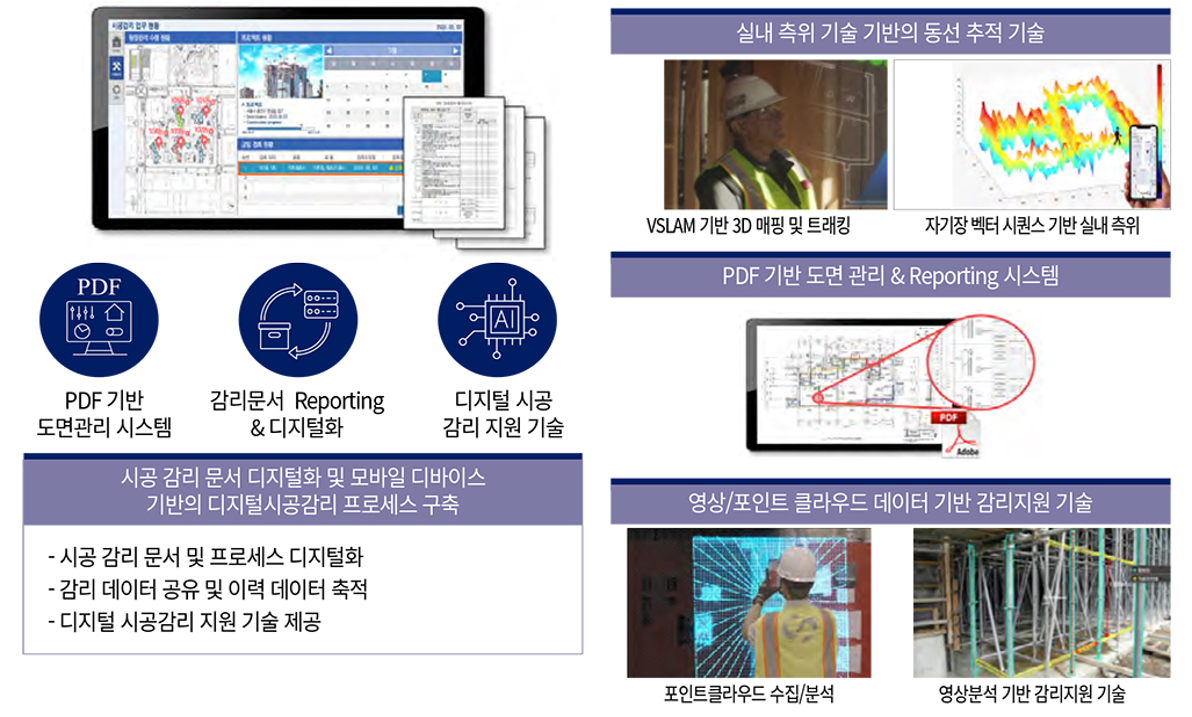
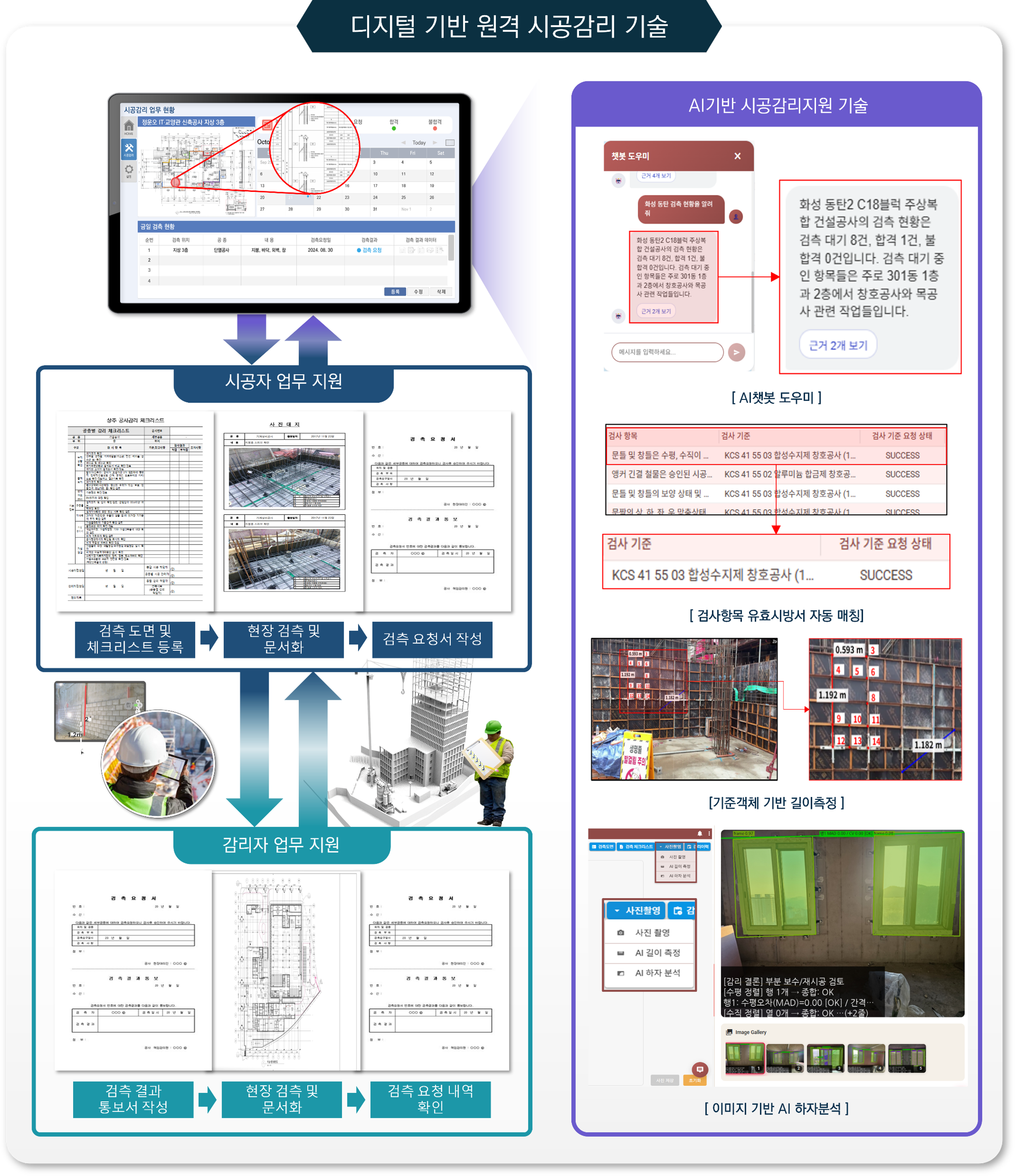
This project aims to enhance construction productivity and safety by transitioning from traditional, labor-intensive, and site-centric workflows to a digitalized and automated supervision framework. The research addresses the limitations of existing paper-based supervision by establishing a digital environment that resolves information discontinuity among project participants. Key technical developments include the digitization of documentation tasks, mobile-based technologies for on-site data acquisition, and the development of analytic algorithms to support supervision duties based on field data.[연구 목표]
Enable digital transformation of construction supervision by shifting site inspection, recording, and reporting to a unified mobile–cloud workflow with strong real-time visibility, traceability, and standardization.
Automate inspection and reporting deliverables (e.g., checklists, inspection requests, result notifications, photo logs, daily work reports) and support automatic submission/integration with PMIS.
Integrate construction automation robots for data capture to improve efficiency and safety in repetitive, wide-area, or hazardous inspection tasks.
Reduce quality and safety risks by minimizing omissions, delays, and human errors and strengthening evidence-based quality management for defect prevention.
[연구내용]
This research aims to transform conventional, paperwork-centered construction supervision into a mobile, data-driven process by leveraging digital supervision technologies and construction automation robots. On site, inspectors use mobile devices to conduct inspections, complete checklists, capture photo/video evidence, and register results in a single workflow, reducing travel, waiting time, and repetitive data entry. The study also standardizes key deliverables—such as checklists, inspection request forms, result notification documents, photo logs, and daily work reports—and automatically generates and manages documents based on structured field inputs to prevent omissions and strengthen auditability and traceability. Inspection results and supporting evidence are automatically transmitted and shared through integration with PMIS or other site management systems, enabling systematic control of review, revision, and approval workflows. In addition, data for repetitive or hazardous areas are captured using automation robots and sensors and linked to the platform to improve inspection efficiency and objectivity. The proposed approach is validated through field demonstrations, quantitatively evaluating impacts such as reduced working time and fewer errors and omissions.
[연구 지원 기관]
국토교통과학기술진흥원
[연구 기간]
Mar. 2024 - Feb.2026